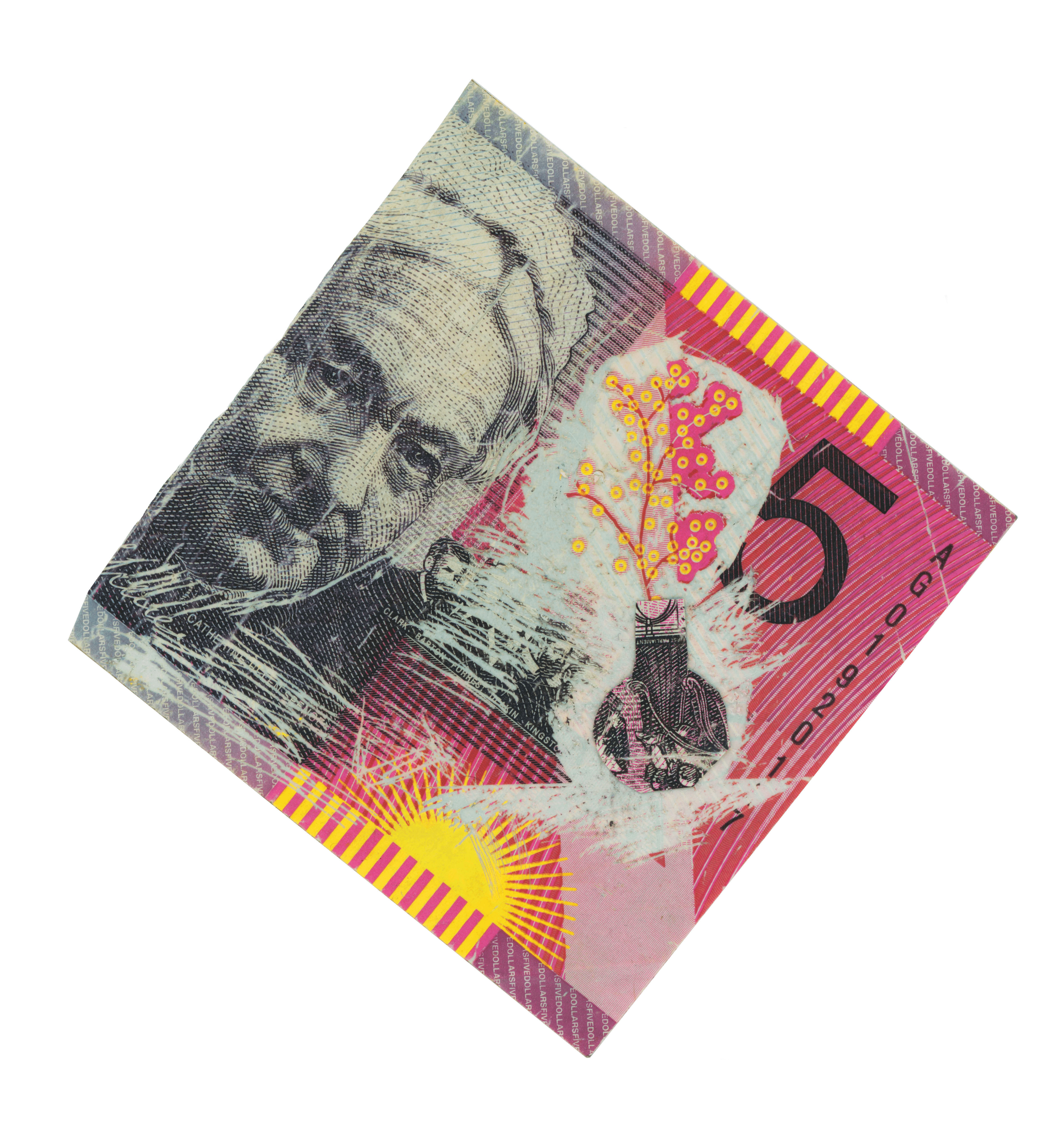
Still Life, 55 x 56 mm, altered banknote/digital image, 2021.
from
“I clench my fists and curse the crowd”
Entranced before me once again,
they sit and sway and sing along,
acting out their roles. As always,
their darting eyes remind me of
those timid sparrows that littered
the cobbled streets, so easily
spooked by the quick clatter of coins
that punctuated our show-tunes
and reedy ballads. Once they’d flown,
Mômone would scrape the copper off
the pavement, as I beamed and snatched
the wisps of claps out of the air.
Our songs would crack under the wheels
of carts and quell the market brawls.
He saw, Louis. He came to watch,
in Winter, when the frost would clip
my throat. “The street is not a stage,”
he said, and thumbed the fur lining
his coat. “Only the sparrows sing
for bread. I own a place, indoors.”
He christened me ‘La Môme Piaf,’
a name that gripped like a corset.
I hated it and told him so,
“but don’t these walls keep out the snow?
You’re drawing in a fortune,” he
said, “keep the name, enjoy the show.”
Amongst the rosy candlelight
and wiry beams of cigarette
smoke, I was learning how to wield
the words, to grind their tone against
the whetstone of my throat, until
my tongue could slit a man in half.
In tears they came to me, after
the curtains closed, to sing their praise
and empty bottles at the bar.
In the summer, I came to them.
Provincial casinos rose
out of the dust as we drove down
dirt-roads, swinging from town to town
where artless pianists hammered out
their brash metallic sounds for me
to drown behind a microphone.
At every stop the numbers grew,
until the shady rooms were packed
and silence only slipped through cracks.
The braying crowds, the seething click
of rusted wheels upon the track.
When the train briefly stopped at a
country station, I felt I heard
a washer-woman working worn
melodies into the morning air
already thick with bright birdsong.
Her tune would rattle my skull
all through the evening, when cigars
and spirits hung like scratches on
the atmosphere. We’d be gone by
the morning.
Notions of ‘performance’ have influenced my work over the last few years, but the events of 2020 helped me to reconsider what it was I meant by ‘performer’ and ‘audience’ in a digital, screen-mediated age. The genesis of my current work was hearing the sound of roaring crowds in empty stadiums at football matches, which let me to think of other elements of art and entertainment that have been replaced by automation. I decided to focus these themes around the singer Édith Piaf, specifically her 1962 concert at the Paris Olympia, after finding elements of her lyrics that posed interesting questions about the relationship between performer and audience. Through the writing of a strictly metrical poetic monologue I wanted to draw attention to the dramatisation of the interior, reflecting the grave physical toll a lifetime of performing had on Piaf ’s health. In Their Eyes Are On The Sparrow (2021), a 36-page booklet containing this monologue and other texts, I aimed to draw parallels between digital automation and fictional reanimation in performative spaces.
Tangentially continuing along this theme in a small series of visual works, I appropriated a variation on the EURion constellation: a code often found on banknotes that tells a computer not to allow digital reproduction of an image. This variation, found on an Australian $5 note, is designed in the shape of a flower, which prompted me to think of the differences in how humans and machines register visual information. In the wake of current events, what objects can be certified as ‘artworks’ in an age of endless reproduction? Whose eyes, real or virtual, are these artworks designed for? and are these works object of beauty and subversion, or of scarcity and exclusion?
Back to the hallway...